
Implant assessment
Implant placement is one stage of rehabilitation. The desired restoration, tissue envelope, anatomy and maintenance capacity determine whether it is a sensible option.
Quick revision summary
Work backwards from the tooth
Define the future restoration, emergence, cleaning route and alternative options before choosing implant position. Bone availability alone does not establish that a functional, attractive and maintainable result is feasible.
Assess biology and transfer uncertainty
Review periodontal and systemic risks, tissue requirements and vital anatomy. Primary stability differs from integration, and a guide requires verified seating and a contingency plan when clinical findings differ.
Plan the lifetime burden
Explain stages, possible augmentation, failure and maintenance as well as surgery. Establish system details and baseline records and demonstrate daily cleaning before handing over the final restoration.
Common mistake
Interpret the findings as a complete support, loading and maintenance system rather than selecting one component in isolation.
Implant assessment
Implant placement is one stage of rehabilitation. The desired restoration, tissue envelope, anatomy and maintenance capacity determine whether it is a sensible option.
Define the restoration before the implant position
Assess the missing tooth or teeth, the patient’s aesthetic and functional priorities, restorative space, smile line, opposing dentition and feasible alternatives. Decide whether the intended restoration is a crown, bridge or overdenture and how it will be cleaned and maintained. The position of the future emergence profile and screw access informs the implant plan.
Assess caries and periodontal disease in the remaining dentition, smoking, diabetes control, medicine history, previous radiotherapy and other relevant healing risks. Consider the patient’s dexterity, attendance and resources for maintenance. An implant can avoid preparation of adjacent teeth, but does not remove the patient’s susceptibility to oral disease.
Osteoclast resorption and osteoblast formation during bone remodelling
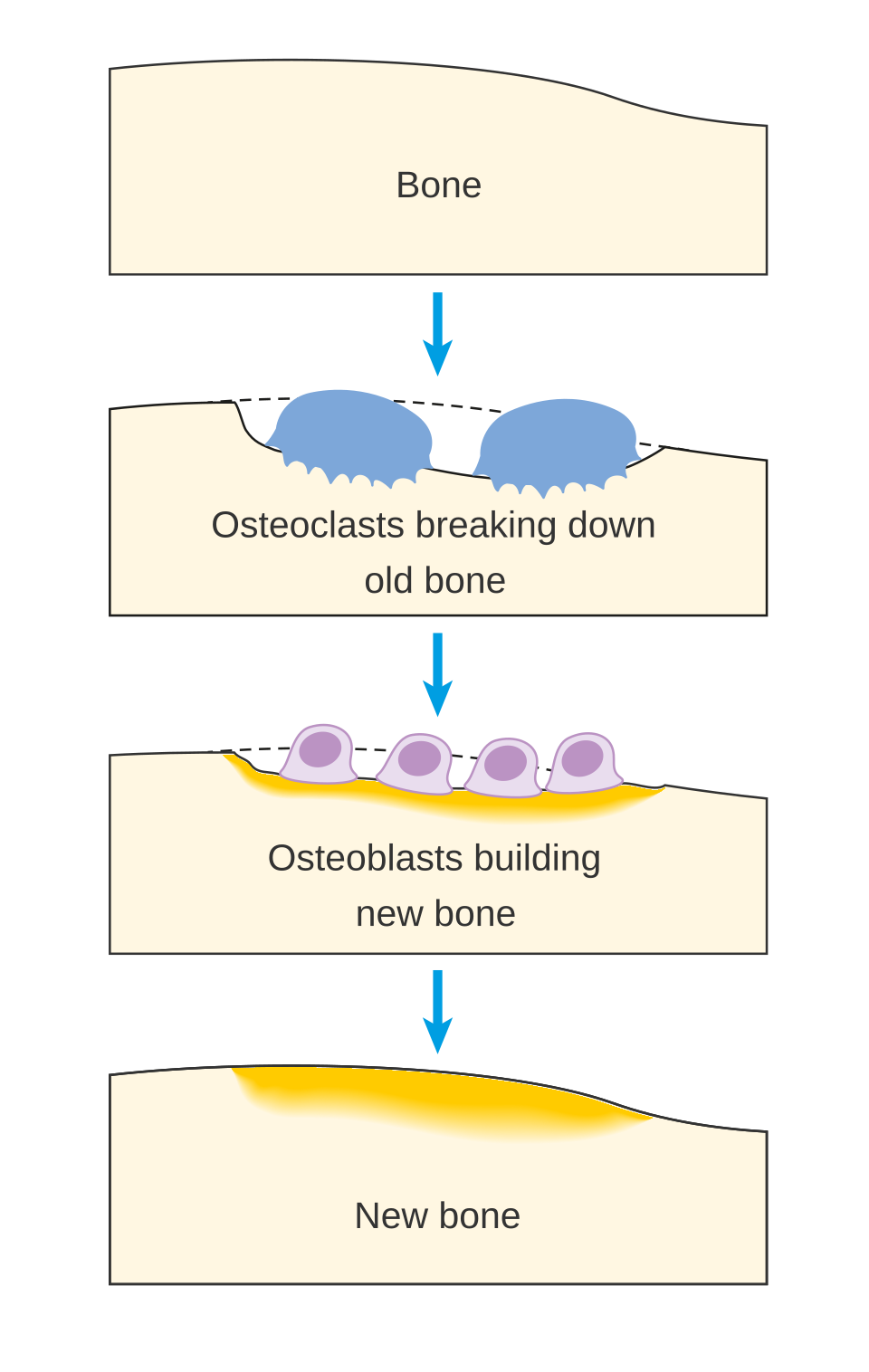
Follow osteoclast resorption and osteoblast replacement, then connect the cycle to antiresorptive therapy and MRONJ. Add osteocyte regulation and the RANK–RANKL–OPG system to this simplified sequence.
Osteoclast resorption and osteoblast formation during bone remodelling · Cancer Research UK (2014; source revision 2016) · CC BY-SA 4.0. Unchanged published raster preview; displayed responsively. Original available from the source.
Assess hard tissue, soft tissue and adjacent anatomy
Use examination and justified imaging to assess ridge form, bone dimensions, soft-tissue volume and nearby structures such as roots, the mandibular canal, mental foramen and sinus. Cross-sectional imaging should answer a clinical planning question and be interpreted over the acquired field. Avoid deriving a universal safe drilling margin from a single illustrative diagram.
Evaluate whether the required position can be achieved within the available tissues, or whether augmentation, a different restoration or accepting the space is preferable. Tissue defects may affect appearance, implant placement and cleansing. Explain the stages, uncertainty, donor-site morbidity if applicable and what would happen if the intended placement cannot be achieved.
Biology and stability are distinct
| Concept | Meaning | Clinical implication |
|---|---|---|
| Primary stability | Mechanical fixation at placement | Depends on bone, implant geometry and placement conditions. |
| Osseointegration | Biological integration with bone | Develops through healing; insertion torque alone does not prove it. |
| Osteogenesis | Bone formation by bone-forming cells | A scaffold does not necessarily supply viable osteogenic cells. |
| Osteoinduction | Signals promoting differentiation towards bone formation | Material claims require product- and context-specific evidence. |
| Osteoconduction | A scaffold permitting bone growth | Recipient vascularity, stability and environment remain essential. |
Grafts, guides and loading decisions
Autograft, processed donor material, animal-derived material and synthetic substitutes have different biological properties, resorption patterns and handling requirements. A barrier membrane may aid compartmentalisation and space maintenance in a selected defect. None makes poor vascularity, inadequate stability or failing soft-tissue coverage irrelevant.
Static guides and navigation transfer a plan through a sequence that includes imaging, registration, guide seating and drilling. Each stage has an error contribution. Check guide fit, access and anatomy and have a plan if operative findings differ. Loading decisions depend on stability, the whole prosthetic arrangement and the selected treatment protocol; a high insertion torque is not a standalone licence for immediate loading.
Consent includes the maintenance burden
Discuss surgical and restorative stages, healing, possible augmentation, failure to integrate, aesthetic limitations and biological or mechanical complications. Explain the need for professional review and daily plaque control around the final restoration. Clarify how a component can be repaired or removed, and identify the implant system and components in the record.
At completion, establish clinical and radiographic baseline information appropriate to the restoration and give the patient a clear maintenance plan. Review access with the actual cleaning aids they will use; an apparently elegant contour may be impractical for a person with limited dexterity.
Separate placement timing from loading
Placement can occur at an extraction visit or after different stages of tissue healing. Loading describes when and how a restoration is connected and exposed to function. These are separate decisions: immediate placement does not automatically imply immediate loading or eliminate the need for a temporary replacement.
The chosen pathway depends on anatomy, infection context, achievable stability, aesthetic risk and the prosthetic protocol. High insertion torque alone is not a sufficient selection rule. Explain the alternative plan if extraction reveals a damaged socket wall, adequate stability cannot be obtained or the intended restoration cannot be delivered safely.
A distinction to remember
Interpret the findings as a complete support, loading and maintenance system rather than selecting one component in isolation.
There is adequate bone but an implant would create an inaccessible emergence contour. Is the site suitable?
Reveal the reasoning
Not on bone volume alone. Assess the intended restoration, implant position, tissues and cleaning access. Consider modifying the plan, augmentation or another replacement option. Integration is only one requirement; the finished result must also function and be maintainable.
Test your recall
What does restoratively driven implant planning mean?
Show answer
Start with the intended tooth position, contours, function and cleaning route, then assess whether implant placement can support that result within the tissues and anatomy. An implant that integrates in an unsuitable position may still produce a poor prosthetic outcome.