
Bleeding after surgery
Distinguish blood-stained saliva from continuing haemorrhage, assess the patient and identify the bleeding source. Reliable local haemostasis and a clear review route are usually more useful than an unplanned change to antithrombotic treatment.
Quick revision summary
Assess severity before the socket
Distinguish blood-stained saliva from continuing active haemorrhage and assess physiology, airway and blood loss. Severe uncontrolled bleeding or circulatory compromise requires emergency escalation alongside local measures within the team’s competence.
Find and control the source
Review timing, local trauma, clot stability and medicines. Apply sustained pressure and inspect appropriately; packing or suturing may be needed. Repeatedly changing gauze without assessing the bleeding site can delay effective control.
Keep medicine advice precise
An antithrombotic history does not prove excessive anticoagulation. Use current guidance and coordinated advice for any change, confirm haemostasis before discharge and give explicit instructions about recurrence, urgent contact and relevant dose timing.
Common mistake
Do not mistake reassuring blood pressure for secure local haemostasis, or solve every bleed by interrupting essential antithrombotic treatment.
Bleeding after surgery
Distinguish blood-stained saliva from continuing haemorrhage, assess the patient and identify the bleeding source. Reliable local haemostasis and a clear review route are usually more useful than an unplanned change to antithrombotic treatment.
Decide whether the situation is immediately dangerous
Ask what is bleeding, how long it has continued, whether pressure has been applied properly and whether the mouth repeatedly fills with fresh blood. Blood mixed with saliva can look dramatic without representing major blood loss, but persistent active flow must not be dismissed. Assess airway, swallowing, breathing, pulse, blood pressure and conscious state when the severity warrants it. Collapse, physiological compromise, uncontrolled haemorrhage or expanding floor-of-mouth swelling requires emergency support and specialist care. Keep a stable patient positioned to avoid swallowing or aspirating blood; adapt the position and resuscitation response if circulation or consciousness deteriorates.
Vascular spasm, platelet plug and blood-clotting cascade
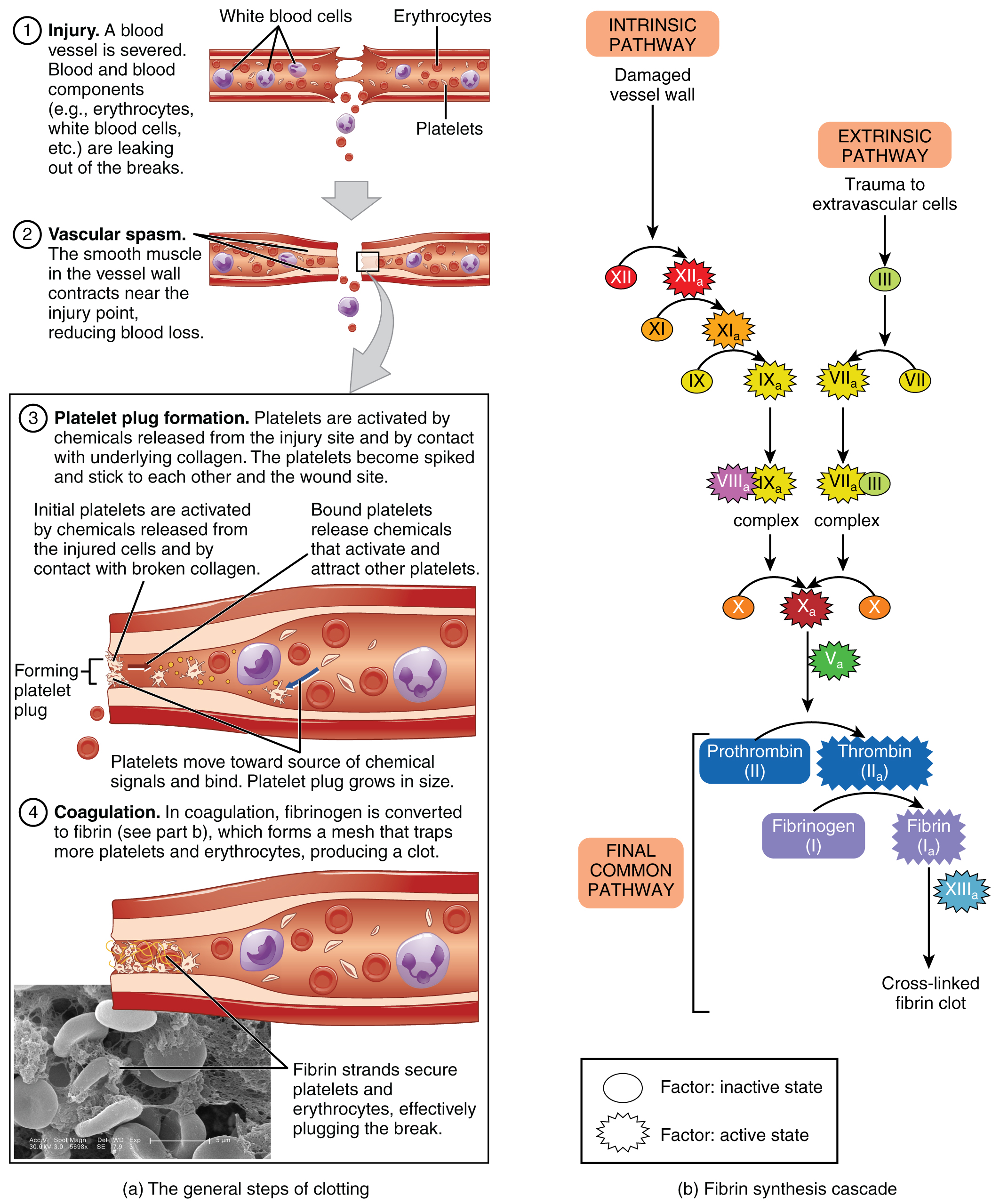
Compare platelet adhesion and plug formation with the development of a fibrin-stabilised clot. Use the labelled intrinsic, extrinsic and common pathways to revise factor deficiencies and laboratory tests. The cascade simplifies the more interconnected process in vivo.
Vascular spasm, platelet plug and blood-clotting cascade · OpenStax College (2013); source micrograph credited to Kevin MacKenzie · CC BY 3.0. Unchanged published image; displayed responsively. Original publication.
Establish the event and the contributing factors
Record the operation, site, timing, surgical difficulty, initial haemostasis and subsequent activity. Immediate bleeding may reflect an unsecured vessel, soft-tissue injury or socket bleeding. Later recurrence may follow clot disruption or local inflammation; timing alone does not establish the cause. Ask about prescribed and non-prescribed antithrombotics, analgesics, alcohol, inherited bleeding problems, liver disease, renal disease and previous abnormal bleeding. Confirm any postoperative DOAC instructions and actual doses taken. A patient may have followed unclear advice inconsistently, so clarify the sequence before interpreting the medicine as excessive or ineffective.
Provide effective initial pressure
Use an appropriate clean damp gauze pack placed directly over the bleeding site, with firm continuous pressure rather than repeated removal to inspect it. Explain the technique and check that the pack is compressing the wound rather than sitting between unrelated teeth. Ask the patient to avoid rinsing, spitting, suction or probing that repeatedly disrupts the clot. Persistent bleeding despite correctly applied pressure needs clinical assessment, not endless remote reassurance. A person unable to bite safely, cooperate or protect the airway needs an adapted supervised approach. Do not place loose small materials in an unsafe airway.
Inspect and achieve local haemostasis
With suitable lighting, suction and anaesthesia where indicated, clear enough unstable clot to locate the source without indiscriminate trauma. Distinguish soft-tissue bleeding from the socket and inspect for a mechanical cause that can be treated. Appropriate absorbable haemostatic packing and suturing can stabilise the wound; use a technique suited to the tissues and material. Confirm haemostasis rather than accepting a temporary pause while the pack is removed. Do not perform blind deep exploration, aggressive repeated curettage or uncontrolled cautery in an anatomically uncertain site. Escalate if bleeding cannot be localised or controlled within competence and facilities.
Interpret medicines and investigations correctly
Follow the exact anticoagulant or antiplatelet pathway rather than advising every patient to stop their treatment. INR is relevant to warfarin, not a measure of DOAC or antiplatelet activity. An unexpectedly high INR, significant coagulopathy or complex combination needs coordinated assessment, but local measures remain important. Specialist investigations may include blood count or coagulation studies according to the history and severity. Do not wait for results before supporting an unstable patient. Tranexamic acid may be used within an appropriate prescribed pathway, but should not be presented as a substitute for finding the source or securing the wound.
Reassess delayed bleeding and associated symptoms
Increasing pain, swelling, fever, discharge or tissue breakdown requires assessment for infection or another postoperative complication. Severe pain without active haemorrhage may instead represent alveolar osteitis or a different process; the management should follow the findings. Worsening bruising or a contained haematoma is distinct from continued socket flow, although an expanding haematoma near the airway can be dangerous. Consider rare vascular injury when the pattern is disproportionate or recurrent despite appropriate local treatment. Repeatedly repacking the same unexplained severe bleed without revisiting the diagnosis can delay the required surgical or medical intervention.
Discharge only with a practical contingency
Before discharge, reassess the site and the patient’s overall state and ensure that bleeding has been controlled. Explain expected blood-staining, how to apply pressure if bleeding recurs, what activities disturb the clot and when urgent help is needed. Provide an accessible contact route, including out of hours, and explicit medicine instructions consistent with the agreed pathway. Consider travel distance, support, frailty and the ability to follow the advice. Document the source, measures, response, any liaison and follow-up. A stable clot at one observation is not enough if the patient has no way to obtain help for recurrent uncontrolled bleeding.
A distinction to remember
Do not mistake reassuring blood pressure for secure local haemostasis, or solve every bleed by interrupting essential antithrombotic treatment.
A stable patient returns with continuous bleeding from an extraction socket after repeatedly rinsing. What is the first clinical approach?
Reveal the reasoning
Assess severity and medicines, then use correctly placed sustained pressure and examine the site if bleeding persists. Identify the source and apply suitable local haemostatic measures, packing or suturing. Confirm control and provide clear instructions rather than reflexively stopping an anticoagulant.
Test your recall
How can blood-stained saliva differ from active post-extraction bleeding?
Show answer
A small amount of blood dispersed in saliva can appear dramatic, while active bleeding produces continuing fresh flow or repeated filling of the mouth. Ask about the pattern and assess the wound and patient rather than judging severity from colour alone.