
Theatre preparation and postoperative care
Know what must happen before and after an operation.
What to expect
A DCT may prepare notes and imaging, confirm investigations, check consent and later review pain, bleeding, nausea, wound, drains and oral intake. Theatre booking and consent roles are governed by local policy and competence; senior review remains central.
What to know
Understand the planned procedure, site and side, relevant imaging, allergies, airway or anaesthetic issues, anticoagulation plan, fasting, blood results and any required perioperative medicines. Check who will communicate with theatre and anaesthetics. After surgery, know the expected course and specific complications to watch for, including airway swelling, haemorrhage, infection, altered sensation, aspiration or poor intake.
A practical approach
Use the operative note and anaesthetic instructions to make the postoperative plan concrete: observations, analgesia, diet, fluids, drain/wound care, medicines, mobilisation, VTE plan, follow-up and discharge criteria. If a patient deteriorates, assess ABCDE and escalate before trying to attribute it to routine postoperative discomfort. Document who was contacted and the response.
Safety point
Never regard a signed form or a routine “post-op well” entry as a complete check. Verify the actual procedure and patient-specific plan.
General anaesthesia and perioperative recovery
GA removes consciousness and protective reflexes and requires an appropriate anaesthetic team, facilities and recovery service. Anaesthesia, analgesia and muscle relaxation are different effects.
Different targets in a balanced anaesthetic
| Effect | Concept | Key distinction |
|---|---|---|
| Hypnosis / unconsciousness | Central effects of anaesthetic medicines | Immobility alone does not prove unconsciousness. |
| Analgesia | Control of nociception / pain | An amnesic or paralysed patient still requires appropriate analgesia. |
| Neuromuscular block | Interference with acetylcholine transmission at the motor end plate | Paralysis does not provide hypnosis or analgesia. |
| Airway control | A planned means of maintaining oxygenation and ventilation | Requires trained assessment, equipment and a rescue strategy. |
| Recovery | Return of appropriate function after drugs and procedure | Includes physiological and practical discharge criteria. |
Neuromuscular junction
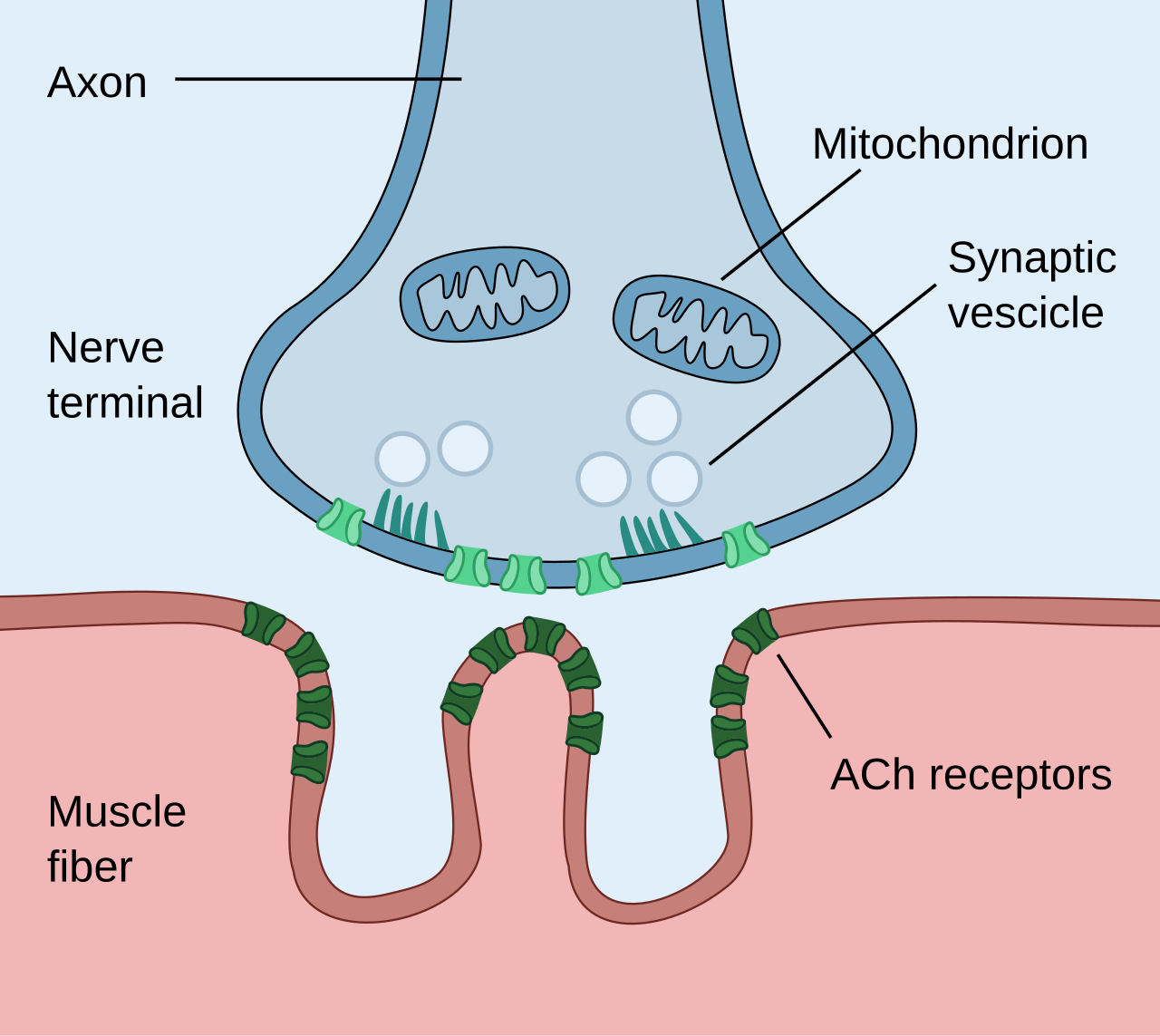
Follow acetylcholine release from the motor nerve terminal to postsynaptic receptors. Connect this synapse to neuromuscular blockers; compare it with axonal sodium-channel blockade in the local-anaesthesia lesson.
Neuromuscular junction · Paul Hege (own work, 2020) · CC BY-SA 4.0. Unchanged published raster preview; displayed responsively. Original available from the source.
Preoperative assessment and airway
Assess the procedure, comorbidity, previous anaesthetic problems, airway, mouth opening, aspiration risk, OSA and functional reserve. Oral surgery shares the airway with the anaesthetic team; bleeding, packs, access and tube position need coordinated planning. An anatomically difficult airway may be made more difficult by infection or trauma.
Use the anaesthetic service’s current fasting and perioperative medicine instructions. Children, diabetes, urgent procedures and particular medicines can require different arrangements. Consent should cover the proposed care and alternatives; do not assume GA is the default response to any anxious patient.
Recovery, handover and discharge
Structured handover includes the operation, airway issues, medicines, blood loss, packs / devices, complications and the postoperative plan. Account for all retained or removable items. Monitor pain, nausea, bleeding, airway and respiratory status in the appropriate recovery setting.
Discharge requires adequate recovery, safe support, clear instructions and a route for problems. Residual sedation, neuromuscular effects or respiratory vulnerability may outlast the operation. Consider the patient’s ability to eat, take medicines, mobilise and obtain help, and coordinate follow-up for the surgical and anaesthetic aspects.
Anaesthesia has separate physiological tasks
Central state
- Hypnosis and appropriate analgesia
- Monitor and titrate the anaesthetic
- Protect against inadequate anaesthesia
Muscle / airway
- NMJ effects and airway strategy
- Maintain ventilation and oxygenation
- Ensure appropriate reversal / recovery
Postoperative care
- Handover medicines and operative issues
- Assess physiological recovery
- Agree discharge support and safety net
A distinction to remember
Neuromuscular blockade produces paralysis, not unconsciousness or analgesia. Recovery is more than opening the eyes.
What must be understood when looking at the neuromuscular-junction figure in a GA lesson?
Reveal the reasoning
It illustrates transmission from nerve to skeletal muscle and the target of neuromuscular blockers. It is not the principal site of local-anaesthetic nerve block and does not explain central hypnosis or analgesia.
Guidance to read alongside this chapter
Bleeding, dry socket and postoperative infection
Distinguish expected recovery from a local complication and systemic deterioration. Timing and the pattern of findings are more informative than pain severity alone.
Bleeding: assess severity and find the source
Start with physiological assessment when bleeding is substantial: airway contamination, breathing, circulation, conscious state and evidence of shock. Ask what has been lost, what has been swallowed, the timing, medicines and the measures already tried. A mouthful of blood can look dramatic, but apparent volume alone does not replace observations or examination.
Identify the socket or soft-tissue source under suitable conditions. Sustained pressure, local haemostatic packing and suturing may be needed. Confirm stable haemostasis before discharge and provide an explicit plan. Persistent bleeding despite adequate local control warrants medical history review, appropriate investigation and escalation; avoid independently stopping antithrombotic treatment.
Vascular spasm, platelet plug and blood-clotting cascade
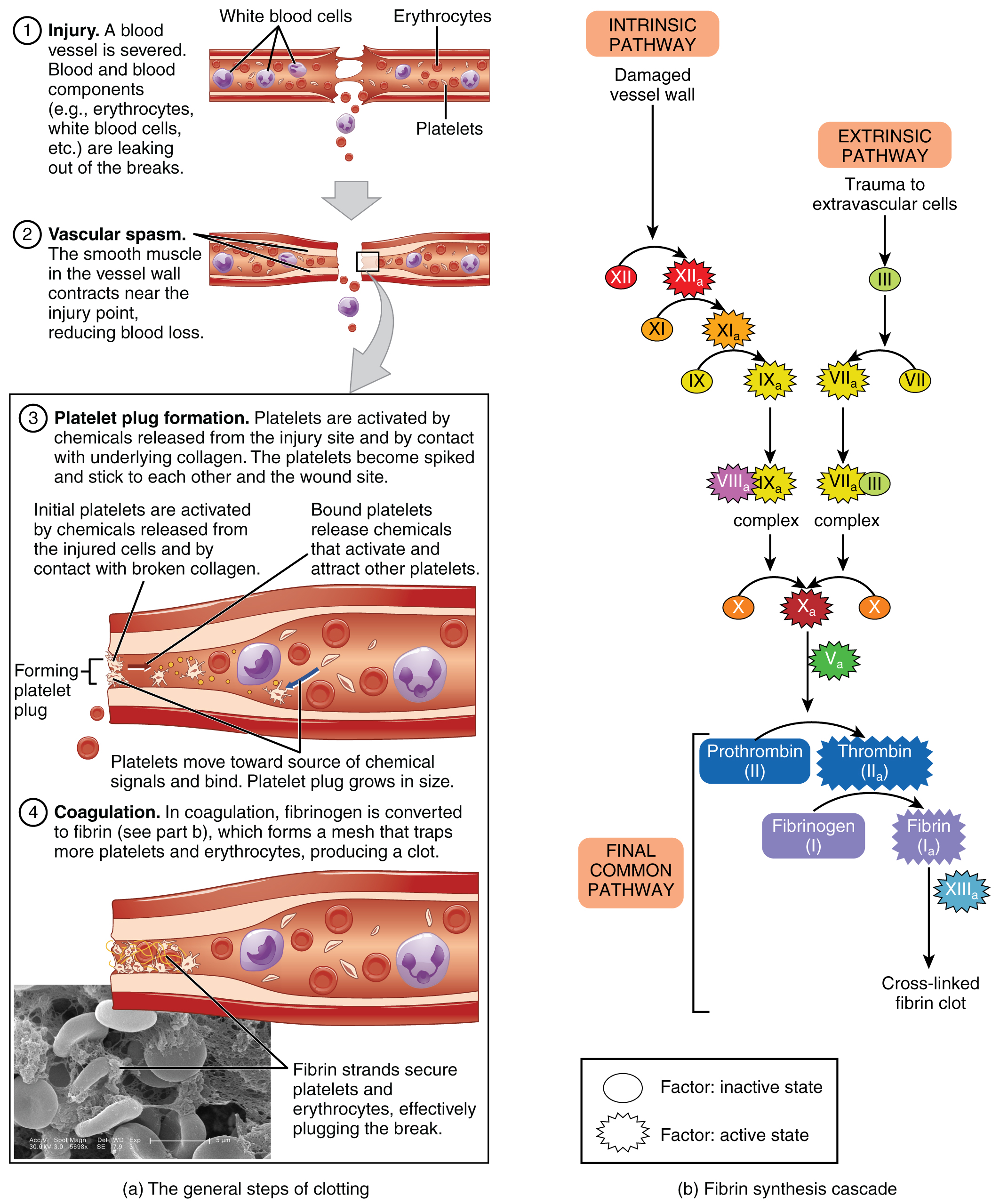
Compare platelet adhesion and plug formation with the development of a fibrin-stabilised clot. Use the labelled intrinsic, extrinsic and common pathways to revise factor deficiencies and laboratory tests. The cascade simplifies the more interconnected process in vivo.
Vascular spasm, platelet plug and blood-clotting cascade · OpenStax College (2013); source micrograph credited to Kevin MacKenzie · CC BY 3.0. Unchanged published image; displayed responsively. Original publication.
Different postoperative patterns
| Pattern | Features that support it | Management direction |
|---|---|---|
| Expected recovery | Pain, swelling and reduced opening that follow a plausible course and then improve | Appropriate analgesia, care instructions and review if the pattern changes. |
| Alveolar osteitis / dry socket | Delayed marked socket pain, disrupted clot and exposed tender bone; systemic infection features often absent | Local assessment, gentle measures / dressing as appropriate and analgesia; antibiotics are not automatic. |
| Postoperative infection | Progressive swelling, purulence, fever / systemic symptoms or spreading signs | Source assessment and control; antibiotics only when indicated; escalate severe spread. |
| Neuropathic or alternative pain | Sensory disturbance, burning / electric quality or persistent pain without a fitting local cause | Investigate the pattern; specialist review rather than repeated irreversible treatment. |
Reassess rather than relabel
A patient can have more than one problem. Dry socket does not exclude an adjacent tooth cause, retained material or subsequent infection. Check the wound, neighbouring teeth, opening, swallowing and sensory findings. Imaging should answer a specific unresolved question.
Review the original procedure and the current medicine plan, including duplicate analgesics and contraindications. Increasing analgesic exposure without reassessing the diagnosis can add harm. Worsening dysphagia, floor-of-mouth elevation, voice change or breathing difficulty requires urgent escalation even if the original operation was minor.
Pain and bleeding require different diagnostic paths
Persistent bleeding
- Assess ABCDE and blood loss
- Identify source and apply local control
- Escalate if unstable or uncontrolled
Delayed socket pain
- Inspect clot, bone and wound
- Check for infection or another cause
- Use diagnosis-specific local care and analgesia
Progressive swelling
- Assess spread, swallowing and airway
- Obtain source control
- Escalate systemic / deep infection
These are pattern guides, not diagnoses made from timing alone.
A distinction to remember
Dry socket is not automatically an indication for antibiotics. A painful socket with systemic illness should not be managed as uncomplicated dry socket.
Three days after extraction a patient has severe socket pain but no progressive swelling, fever or purulence. What should be checked before prescribing antibiotics?
Reveal the reasoning
Assess the socket for clot loss and exposed tender bone, look for other local causes and confirm the absence of spreading or systemic infection. Alveolar osteitis generally needs local care and analgesia rather than routine antibiotics.
Guidance to read alongside this chapter
Test your recall
What should a postoperative handover include?
Show answer
The operation performed, airway and bleeding concerns, observations, analgesia, diet/fluids, drains, medicines, review and escalation plan.